
Chinese Export Art Short Course 2026 Gathers Academics and Museum Experts for a Shared Exploration
The four-day multi-city experience concluded after drawing a diverse art community to Hong Kong, Macao, and Guangzhou for a deep dive into Chinese export art.
-
From 14 to 17 October 2026, the Chinese Export Art Short Course 2026, organised by the Hong Kong Maritime Museum (HKMM) and sponsored by the Susan Chen Foundation, was successfully held across Hong Kong, Macao and Guangzhou.
Through four intensive days of lectures, object-based learning, exhibition tours, heritage visits, group discussions and presentations, the course offered participants an in-depth exploration of Chinese export art from multiple perspectives, including artistic production, commercial trade, global networks and cross-cultural exchange.

A Cross-Regional and Interdisciplinary Platform for Chinese Export Art
The course brought together participants from diverse academic and professional backgrounds, with guidance from six scholars and museum specialists. Through close engagement with museum collections and objects, participants explored the history, material culture and global circulation of Chinese export art, while gaining insights into collection management, curatorial practice, museum education and research methodologies.
The programme also encouraged interdisciplinary dialogue between Chinese export art and related fields, including art history, maritime history, archaeology, material culture, fashion and textiles, museum studies and heritage studies. It provided valuable opportunities for exchange among participants, scholars and museum professionals.

Day 1 | Hong Kong
Understanding Chinese Export Art through Maritime Trade and Material Culture
The course began at the Hong Kong Maritime Museum. Jeremy Michell, Deputy Director (Curatorial and Education), led participants through the Museum’s C Deck galleries. Beginning with ancient Chinese shipbuilding technology, developments in navigation and the Maritime Silk Road, the tour explored the maritime and trading networks that gradually connected China with Asia, Europe and Africa.
Interpreting Maritime Exchange through the Museum Collection
The object-based learning session focused on the Museum’s Gentiloni paintings and an eight-panel wooden lacquer screen dating to around 1690 depicting the cityscape of Qing-dynasty Guangzhou. By examining composition, perspective, light and shadow, ships, harbour scenes and craftsmanship, participants explored maritime trade, urban development and Sino-Western visual and cultural exchange during the seventeenth and eighteenth centuries.

“Understanding Guangcai: Decoding the Secrets of Overglaze Decoration”
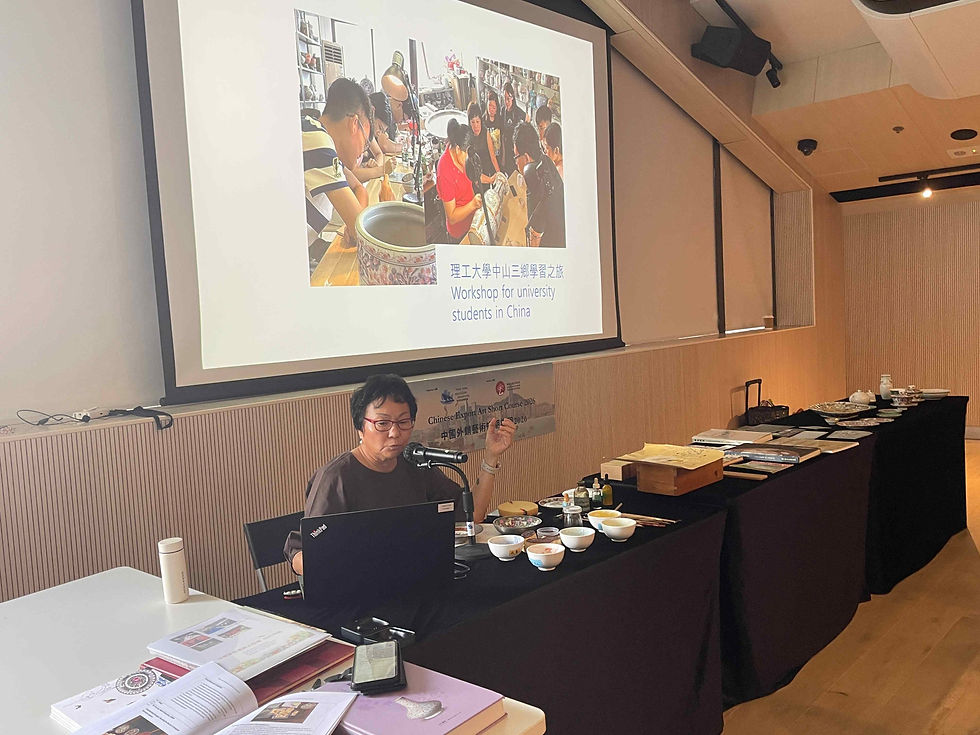
Cora Lee, Head of Education at the Hong Kong Maritime Museum, led a special session, “Understanding Guangcai: Decoding the Secrets of Overglaze Decoration”Using objects, books, tools and materials provided by Ms Ho Liu Yee Ling, Chairperson of the Hong Kong Ceramics Research, the session introduced the art of Guangcai overglaze decoration and explored Hong Kong’s role as a centre of trade and commerce in the production, circulation and continuation of this artistic tradition.
Participants also considered overseas market demand, customised designs and production costs to explore how Canton enamelled porcelain adapted to the needs of different international markets and remained competitive.
Understanding Cantonese and Export Art through
Collecting and Curating
In the afternoon, participants visited the Hong Kong Museum of Art (HKMoA) to explore exhibitions including “Proudly from Canton: The Muwen Tang Collection of Cantonese and Export Art” and “Art Personalised: Masterpieces from the HKMoA.”
Through comparisons of museum collections, exhibition interpretation and group discussions, participants considered how collecting practices, connoisseurship, commissioning relationships and audience demand shaped the imagery, design and functions of export art.

Day 2|Macao
Tracing European Commissions, Religious Art and the Circulation of Kraak Porcelain
On the second day, the course moved to Macao, examining the maritime trading networks established by the Portuguese in the sixteenth century and Macao’s important role in the development and global circulation of Chinese export art.
The Portuguese were among the early commissioners of Chinese export art and helped facilitate the circulation of Chinese artworks around the world. Commissioned Catholic paintings, sculptures, crosses and liturgical objects demonstrate interactions between Chinese and European artistic traditions. Archaeological discoveries in Macao also provide important material evidence for the study of early global trade.
Macao Museum: Understanding Kraak Porcelain through Archaeology
Participants first visited the Macao Museum to examine Kraak porcelain and related archaeological objects. They explored how Portuguese maritime trading networks contributed to the emergence and global circulation of Kraak porcelain, and how Christian imagery on porcelain reflected the religious beliefs, tastes and commissioning requirements of European consumers.

Heritage Visit to the Ruins of St Paul’s
Li Jun, Head and Chair Professor of the Department of Arts and Design, Faculty of Arts and Humanities at the University of Macau, led participants on a heritage visit to the Ruins of St Paul’s and the Museum of Sacred Art and Crypt.
Through architectural decoration, religious art and archaeological remains, participants identified decorative motifs comparable to those found on Kraak porcelain and considered how Chinese and Western artistic cultures encountered, transformed and coexisted with one another in Macao.

A-Ma Temple and the Macao Maritime Museum
The programme also included visits to A-Ma Temple and the Maritime Museum. A-Ma Temple predates the development of the city of Macao, and its different halls embody elements of Confucianism, Taoism, Buddhism and folk beliefs.
The Macao Maritime Museum introduced Macao’s maritime traditions and technology, the traditions of fishermen in Macao and South China, and maritime exchange between China and Portugal from the fifteenth to seventeenth centuries. Participants considered how Macao, as an important port, facilitated cultural exchange between China and the wider world through religion, navigation, commerce and community life.
From Portuguese Carracks to Kraak Porcelain
The term “Kraak” porcelain derives from the Portuguese Carracks that transported Chinese ceramics to Europe during the sixteenth and seventeenth centuries. With the development of Dutch trading networks, Kraak porcelain became one of the representative forms of Chinese blue-and-white export porcelain produced between the Wanli and Chongzhen periods of the Ming dynasty.
Zhao Qiang, Researcher at the City University of Macau, guided participants through the university’s collection of Kraak porcelain, introducing six principal stages in its development. He also led an object-based learning session in the conservation laboratory. Participants examined ceramic fragments, Buddhist sculptures, paintings, tomb bricks and other teaching objects from different periods, observing their bodies, glazes, firing techniques and decorative characteristics.

Day 3|Guangzhou
Reconstructing the History of Export Art through Curating, Interpretation and Exhibition Practice
The third day took place at the Guangdong Museum under the theme“Exploring Curatorial Approaches to Export Art of the Qing Dynasty” The programme examined the role of Qing-dynasty Chinese export art in connecting China and the wider world through commercial and cultural exchange.
Curatorial Approaches to Qing-Dynasty Export Art
The lecture used the Guangdong Museum’s collections and exhibitions as case studies to examine provenance research, object analysis, collection interpretation, exhibition design and curatorial practice. Participants discussed how museums research, preserve and present Chinese export art, as well as the challenges involved in interpreting this material for contemporary audiences. The discussion also considered how export art can be situated within broader histories of global exchange, collecting and cross-cultural encounters.

A Millennium of Commerce: Guangdong’s History of Foreign Trade
In the afternoon, participants visited the exhibition“Shared Prosperity: A Millennium of Guangdong’s Foreign Trade”. The exhibition introduced institutions and policies that shaped overseas trade from the Tang and Song dynasties onwards, including the Maritime Trade Supervisorates, trade networks connecting Guangzhou and Macao during the Ming dynasty, the Qing single-port trading system, the Thirteen Hongs district and the administration of the Canton Customs.
Through the exhibition tour and discussion, participants further examined how Guangzhou’s trade policies, maritime networks and the Thirteen Hongs system supported the production, commissioning, trading and global circulation of Chinese export art.

Tutor-Guided Group Presentation Preparation
Participants then worked in groups under the guidance of tutors to prepare their final presentations, discussing how the public understands, interprets and engages with Chinese export art, and how museums can further enhance public understanding of the field.

Day 4|Guangzhou
Returning to the Sites of Production and Trade
The final day focused on“Provenance of Origin,” taking participants into the historic landscape of Guangzhou’s Thirteen Hongs and museum collections to reconsider Guangzhou’s role as a centre of artistic production, an international trading port and a hub of cultural exchange.
Walking Through the History of the Thirteen Hongs
As one of the most recognizable symbols of Guangzhou’s maritime trade, the Thirteen Hongs became a prominent motif in Chinese export paintings, reflecting the city’s pivotal role in China’s engagement with the wider world. By linking the imperial state, local officials, Chinese merchants, and foreign traders, this system created the commercial environment that enabled the production, exchange, and global circulation of Chinese export art.
Participants visited the Guangzhou Thirteen Hongs Museum, located on the historic site of the Qing trading district, where documents and objects illuminated the role of Hong merchants in facilitating commercial and cultural exchange between China and the West. They also explored the surrounding historic trading area and had the opportunity to speak and have lunch with Wang Heng, the Connoisseur and the Honorary Director of the Museum, gaining insights into the history and experience behind his collection.

From Cloud Collars to Manila Shawls
In the afternoon, participants visited the Guangzhou Museum exhibition"Glamours on Shoulders: Chinese Cloud Collars and Manila Shawls”. Combining Canton embroidery techniques with overseas market demand, Manila shawls travelled through maritime trading routes via Manila to Europe and the Americas, becoming an important example of transregional fashion.
Through cloud collars and Manila shawls, the exhibition demonstrated how object forms, decorative motifs and cultural ideas travelled and transformed across regions, highlighting Guangzhou’s dual role as a centre of traditional artistic production and an important gateway for China’s foreign trade.

Bringing Together International Academic and Museum Expertise
The course tutors included:
Bai Fang, Curator and the Director of Exhibition Department, Guangdong Museum
Patrick Conner, Independent Scholar, Research Fellow at Victoria & Albert Museum
Karina Corrigan, Deputy Chief Curator and The H.A. Crosby Forbes Curator of Asian Export Art, Peabody Essex Museum, USA
Alexandra Loske, Curator of the Royal Pavilion, Brighton, UK
Wang Lianming, Associate Professor,Department of Chinese and History,
City University of Hong Kong
Course experts included:
Kwok Tak Yee, Assistant Curator II (Chinese Export Art), Hong Kong Museum of Art
Cora Lee, Head of Education, Hong Kong Maritime Museum
Li Jun, Head and Chair Professor, Department of Arts and Design, Faculty of Arts and Humanities, University of Macau
Jeremy Michell, Deputy Director (Curatorial and Education), Hong Kong Maritime Museum
Zhao Qiang, Researcher, City University of Macau

Putting Learning into Practice and Sharing Research
The course concluded with group presentations and a certificate presentation ceremony. Drawing together insights from four days of lectures, object-based learning, exhibition visits, heritage tours and professional exchange, participants shared their observations on contemporary research, interpretation and public engagement relating to Chinese export art.
Eugenie Hardy, General Manager of Susan Chen Foundation, and Richard Kendall, Director & CEO of the Hong Kong Maritime Museum, presented certificates to the participants at the closing ceremony.

Connecting History through Objects, and the Maritime World with the Globe
The four-day learning journey began with Hong Kong’s maritime history and museum collections, continued in Macao by tracing early Sino-Portuguese trade, religious art and the circulation of Kraak porcelain, and concluded in Guangzhou with an exploration of Qing foreign-trade systems, the history of the Thirteen Hongs, curatorial practice and the origins of export-art production.
Through cross-regional field study, object-based learning and interdisciplinary dialogue, participants deepened their understanding of the cultural, historical and global significance of Chinese export art while building connections among academic research, museum practice and public education.

Organised by: Hong Kong Maritime MuseumSponsored by:Susan Chen FoundationDate:14-17 / 10 / 2026Venue:Hong Kong、Macau、Guangzhou
#HongKongMaritimeMuseum #ChineseExportArt #ArtHistory #MaritimeSilkRoad #MuseumEducation #ObjectBasedLearning #CrossCulturalExchange #HongKong #Macao #Guangzhou